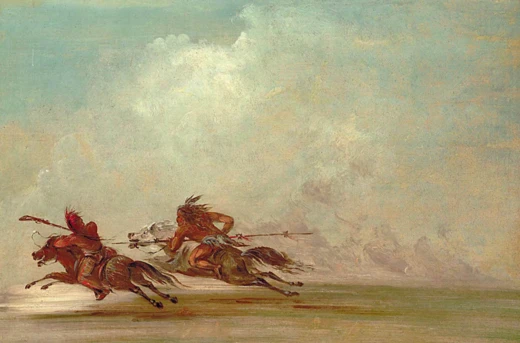
Dunes
Every crest is a killzone; every slope is a launchpad.

Dunes is a desert-themed map in the Tribes series, most prominently featured in Tribes 2 (2005). Set across rolling sand dunes, sparse rock outcroppings, and open scrubland, the map leverages the franchise's signature top-down perspective and physics-driven movement to turn every slope into a tactical variable. Players gain real momentum pushing downhill and must manage their speed on the crests, making the terrain itself a weapon as much as any rifle.
As one of the more open, line-of-sight-heavy environments in the roster, Dunes rewards players who understand the physics engine's interplay with elevation. It stands in contrast to the tighter, cover-dense urban and industrial maps, demanding a more mobile, momentum-based playstyle.
- Game
- Tribes 2 (2005)
- Setting
- Desert / sandy dune terrain
- Perspective
- Top-down (2.5D)
- Developer
- Volition, Inc.
- Publisher
- Sierra Entertainment
- Terrain character
- Open, elevated dune crests with limited natural cover
Lore & Background
In the world of Tribes, the Dunes region is a stretch of arid, wind-sculpted terrain where sand has been carved into long, parallel ridges by centuries of relentless wind. The landscape is largely devoid of permanent structures, save for scattered rock formations and the occasional half-buried wreckage of earlier conflicts. The open sky and long sightlines mean that no position is truly hidden for long; the dunes themselves become the only meaningful cover, and the angle of a slope can determine whether a shot connects or a vehicle holds its line.
The community of players who gravitate toward Dunes often describe it as the map where the physics engine becomes the most visible. The top-down camera lets you see the full curvature of a dune, and the game's momentum system means that a well-timed downhill push can carry a player across the map in seconds. Veteran players speak of 'riding the crest'—holding the top of a dune to maximize line-of-sight while using the slope behind them as an escape vector.
Unlike the industrial or urban maps where cover is abundant and fights break into close-quarters brawls, Dunes forces a more open, duelist-style engagement. The scarcity of hard cover means positioning, timing, and momentum management become the primary tools of survival.
In Their Own Story
The sand was still moving when Kael crested the ridge. Below, two shapes were already sliding down the far face, gaining speed the way a stone does off a slingshot. He didn't fire. He let them come. The dune's slope fed his own momentum as he dropped, boots kicking up a thin ribbon of grit, and by the time the first one looked up he was already level, already closing. The second one saw him a half-second too late. The sand swallowed the echo.
Reader's Guide
Dunes is fundamentally a momentum map. The top-down camera means you can see the full profile of every dune, and the physics engine rewards players who commit to a downhill push: you gain real, compounding speed that carries you across open ground and makes you a harder target to track. The crests are the primary tactical real estate—holding the top of a dune gives you a slight elevation advantage and a long, unobstructed sightline down the far slope.
The map punishes hesitation in open stretches. There is very little hard cover—no walls, no crates—so the only meaningful concealment is the dune itself. If you are on the flat between two ridges, you are exposed. Use the windrows and shallow gullies as soft cover, but do not mistake them for safety against a player who has momentum on their side.
Vehicles change the calculus. On flat ground a vehicle is a target; on a slope it becomes a projectile. A well-timed downhill charge in a vehicle is nearly impossible to dodge, but the same vehicle on the crest is sitting still and picking up bullets. Community players often call the long central ridge 'the highway' because it is the most common route for vehicle charges, and the flatter basins between dunes 'the kill floor' because anyone caught there without a slope to escape onto is in serious trouble.
Positioning beats raw aim here. Learn the dune profiles, time your pushes, and use the terrain's geometry rather than fighting against it.
Did You Know?
- Tribes 2's top-down perspective was a deliberate design choice by Volition to differentiate the series from the standard horizontal-view FPS genre of the early 2000s.
- The physics engine in Tribes 2 gives players genuine, compounding momentum on slopes, meaning a dune map like Dunes turns terrain geometry into a core mechanical skill rather than just a visual backdrop.
- Because the camera looks straight down, dune crests provide only a slight visual elevation cue rather than a dramatic height difference, making 'holding the crest' more about sightline geometry than true verticality.
- Tribes 2 was developed by Volition, Inc., the same studio behind the Saints Row and Red Faction franchises, and published by Sierra Entertainment.
More in Maps & Environments
Elsewhere in the Tribes universe
Spotted an error? Know more?
This is a living reference — every entry is fact-audited, and reader corrections feed straight into our audit queue. Suggest an edit · See this site's audit record